![[personal profile]](https://www.dreamwidth.org/img/silk/identity/user.png) fruzicle
fruzicleGlossary
Þorfinnr= pronounced Thorfinnur, protagonist
Grönland =Greenland, pronounced Grunland
Solar steinn= sun stone
Vinland= probably Newfoundland
Letters and their sounds:
Þ or þ, a voiceless TH sound, as in thing or thin or with
Ð or ð a vocalized Th sound, as in "the"
"Það er frekar dimmt"= Thathe are frekar dimmt (Icelandic)=It´s pretty dark
Hei du= hey doo= Hey, you
Eirik, pronounced EYE rik
Harald, pronounced Hah rald
skål= pronounced skoal, the Nordic toast
Helge= Hel geh
Atle= Ott leh
aquavit, brennevin= The hard liquor of Norway, plus a more generalized term for it. Literally, brennevin translates to 'burning wine,' closely matching the English term 'fire water.'
Fy, fan= curse words in Norwegian, pronounced something like Fee and fa'an. (To properly say Fy, purse your lips together as if you were about to kiss someone, then say 'fee.' With these two words alone, you should be well equipped to express yourself up north!
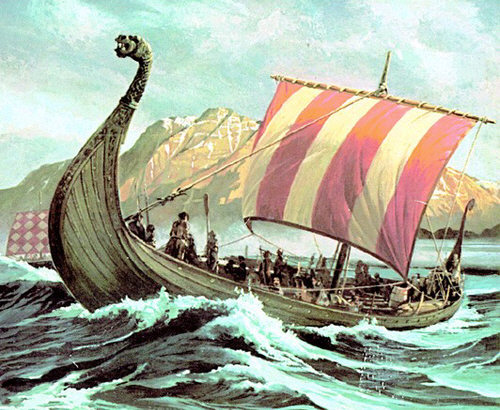
Þorrfinnrs face was pelted with fat drops of ocean spray as he peered out ahead of the ship. He gripped the aft dragon post with one hand and spread his legs, the better to keep his balance on the heaving deck. Everywhere he looked, the mountainous ocean rose and fell in a never-ending gray expanse. White foam danced upon the rising swells like a mantle of lace over the frigid peaks.
At least it isn’t actually raining, he thought, even though the flying spray made it feel like it was. He clutched his red wool cloak more tightly around him to keep out some of the wind. It’s just a few hours before noon, he thought. I hope the clouds will thin enough to do a sighting on the sun.
The rest of the men huddled out of the spray. The sail had been set and the ship was making good headway. It had been three days since they had left Grönland. The goal was to get to Vinland, to the south and west, where the rumor was that there was timber to be had as well as good pasturage for farm animals. Grönland was no longer as hospitable as it once was. The weather was getting colder, the land was barren, and the Viking farmers were getting tired of living off of little more than seals and fish.
Indeed, as the morning advanced, Þorfinnr was pleased to see that the clouds had lessened their heavy, dark shield over the sun. "Hei du! Eirik! he called. "Come help with the navigation!"
Eirik emerged from under a waxed and oiled cloth where he and others had been sheltering out of the spray. He carried with him a small leather bag. He glanced skeptically at the glowering gray clouds as he fished a clear block of crystal from the bag. It was as clear as frozen water and had lovely slanted edges at each end. It was just as the gods had made it. No man or woman had shaped its edges.
"Okay, here is the solar steinn," he said."Let´s hope it works. Það er frekar dimmt. It´s pretty dark today."

He held it such that the hidden sun could pass its rays through it onto a lightcolored piece of cloth. A very faint image appeared. Eirik then pulled another small item from his bag. This disc he placed in front of the solar stone such that the light beam travelled through the stone and then through a small hole in the disc. An image of the sun was focused on the cloth.

"There!" urged Þorfinnr. "That´s where the sun is." Both men looked up and took careful note of the placement of the hidden sun relative to their direction of travel. Eirik called to a crew mate, "Harald, bring an ember and a torch!"
Harald now also scrambled out from under the tarp carrying a bowl containing a burning ember and an unlit torch. The torch was then ignited with the ember and Harald held it where the sun had been shown to be. This activity was performed several times a day, so everyone knew just what their part in the procedure was.
Eirik pulled a third small tool from his leather bag, a shadow dial. It also was no bigger than his palm. It was made of wood and resembled the sundials they used on land, complete with a protruding gnomen in the center of the dial. A second, horizontal bar also helped with their readings.
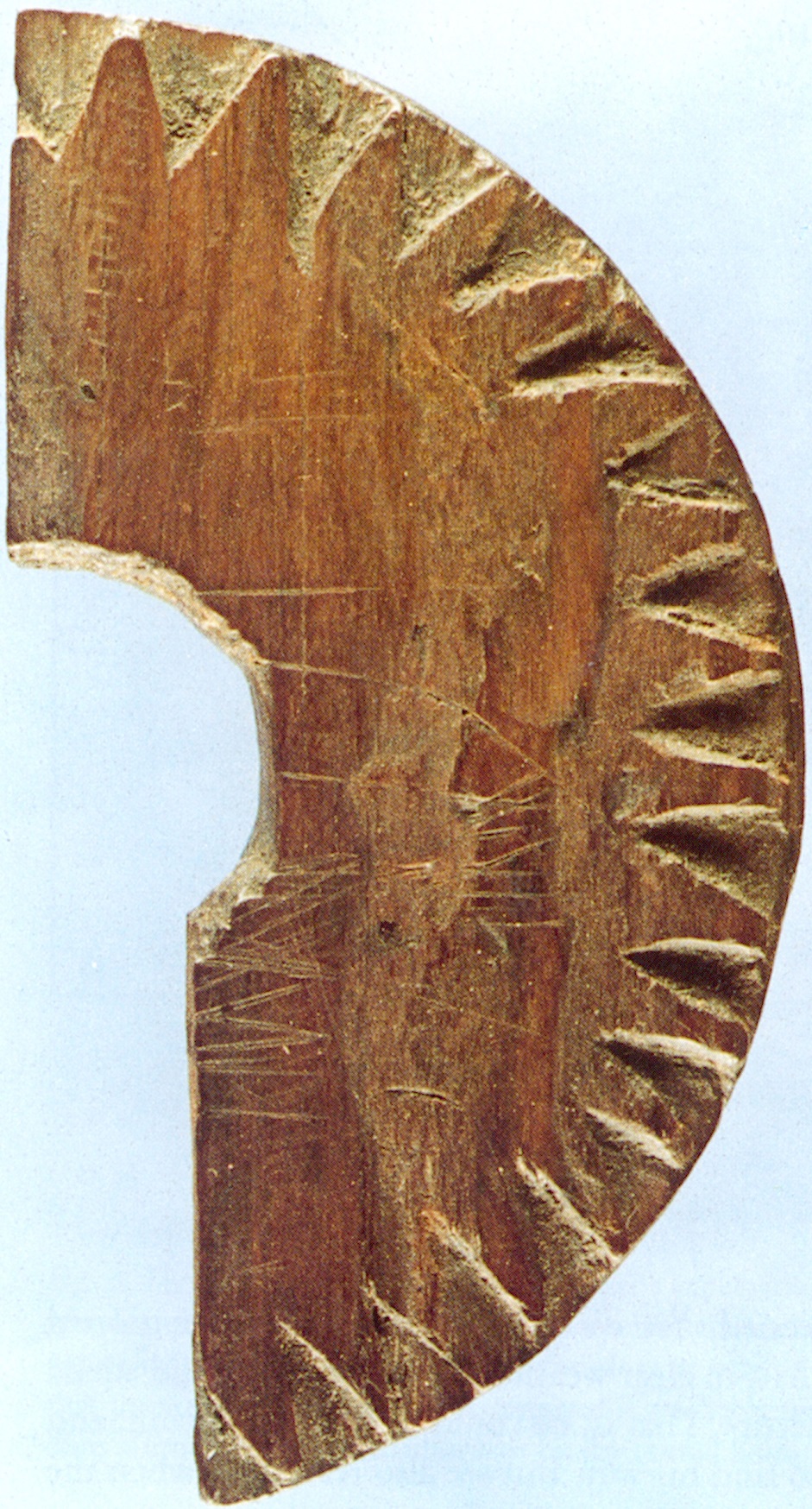


Using the torch as a substitute sun, the men placed this new dial so that the torch shining on the gnomen would cast a shadow upon its face. Knowing where the sun was, allowed the men to recognize the direction of north. Markings on the shadow dial were calibrated to show when the shadow was the shortest, and thus marked noon. (Earlier or later in the day would cast longer shadows.)
“All right, men. That’s good for now. Let’s take more readings as the day progresses and we’ll figure out when noon actually is,” Þorfinnr commanded his crew.
As the day progressed, more readings were taken. The readings from noon were determined and used to orient the sail and steering keel to keep them on their southwesterly course.
Life on board was spare. It was usually cold and often wet. Sometimes it was sunny and other times, cloudy. But the stories of those who had gone before them guided their path. Day after day, the sun stone helped them find the way. And, as an amazing boon, it even worked its magic after the sun had set in the evening but the sky was still bright. Because it was the far north, and summer time, those bright evenings lasted for hours.
In a few weeks they saw land in front of them. All aboard were thrilled. In spite of their competence, it was cause for celebration and a round of brennevin.
"Skål! Skål!" they shouted in jubilation.
Henceforth, they followed the coast and after a lengthy southward journey they found a promising landing point. The crew knew they would be returning to Grönland in a year or two, but for this winter, they built an encampment, planted some crops, and made a comfortable enough life for themselves. This place was fruitful. They found berries and grapes and wild growing wheat. They planted barley. Having been used to the harsh winter conditions of Grönland, they rejoiced in a mild winter with little snow. What a place!
Two years later, they made the return trip to Grönland towing a sizable cargo of timber. They exclaimed to their families about the fabulous lands they had experienced. The tales they told grew in glory.
And the saga was passed through the generations with instructions for those who also might dream of going to a place of bounty and warmth.
Lars Eirikson stood on the deck of his sailing ship and stared with consternation at the ice-locked scenery before him. It was 1623, nearly five hundred years since the saga he had read that described the wonderful landscape his Viking forebears had discovered. The instructions were vague but Lars figured, with the most modern technology, his magnetic compass, he ought to be able to find this promised land without snow.
Though Captain Eirikson's crew pushed off with optimism and toasted their launch with a round of aquavit, and congratulatory skåls, things became strange right from the beginning of the voyage. Eirikson had headed west from his homeland in Norway. He tried to use his compass in the beginning, but for some reason it pointed south when it should have pointed north. He gave up and paid attention to the sun. On cloudy days he really wasn’t sure which way to go. On those days he turned back to using his compass. Strangely, the journey across the cold sea seemed to take much longer than expected. The crew started complaining when the journey seemed to drag on and on without seeing Iceland, like they expected. When the sun would come out, they took the opportunity to turn west again, but Lars couldn’t figure out exactly where they were.
He would have liked to turn around and go back. But which way was back? Even though he was equipped with the most modern technology and felt he could point with certainty which way was the true north, he floundered. And their store of dried fish and shark was running low. The men's stomachs were growling with hunger. Lars Eirikson found himself privately growing more and more depressed. Each evening he looked more and more to the company of his old friend, brennevinn. He asked himself, "What am I missing?
In the year 1963, two weather-beaten sailors relaxed in the aft cabin--the captain's quarters--of their fishing boat. Helge, the captain, offered his first mate, Atle, a glass and plunked a full bottle of aquavit onto the table. As they were docked in the harbor, the table hardly moved, though it was mounted on gimbals so that the table would swivel during high seas to hold the surface level when the ocean was anything but. But they had had a bountiful catch, the fish had been sold and off-loaded, and now there was time to shoot the breeze.
"Fy, fa'an it's a good thing we had that GPS," swore the mate. "Without it I doubt we would have made it back home." He tossed back his entire shot glass of brennevinn.
Aye, ja, you know that is true," responded Helge. "That was some heavy weather." And he emptied his glass, then immediately refilled both glasses.
"How did those Vikings manage? And their ships were open to the sky! No clever little space heaters for them, not like what you've got in your wheel house." Atle ribbed the captain about what had become an ongoing joke between them about their modern 'cushy' ways.
"Ja, you work as hard as we do, you deserve some creature comforts." Helge wasn't giving in to the accusation of a soft life. "Just like brennevin. Fill 'er up again."
"Hey, what do you suppose ever happened to the Lars Eirikson voyage? Remember that one? They just disappeared off the face of the earth." Atle sipped his drink with a little more reserve this time.
"Well, I have a theory about that one. Strange how our ancestors were so good with their old tried and true systems. But I'm guessing unlucky Lars Eirikson had advanced enough knowledge to have forgotten the Viking ways, but relied upon his newer faith in his compass. What he didn't know was that magnetic north is in a much different place than true north. Your compass will tell you some strange stuff out there. I think he got lost. Probably starved to death out there. Like we would have if we didn't know about the bending of the lines of magnetism. Or had our GPS," he added.
"Here's to having reliable navigation equipment," toasted Atle.
"Ja, ja. Sunstones and sun compasses in the gamle dager, the old days. Decent maps..." Helge downed his firewater.
"To GPS systems!" cheered Atle.
"And a heater!" Helge wasn't going to let that one go.
The two men stared at each other in that tired and relaxed happy state after a hard week's work.
Simultaneously they raised their glasses.
"To brennevin!" they exclaimed.
"Skål!" they shouted simulataneously.
To retrace the steps of research, please feel free to visit these sites.
https://maps.ngdc.noaa.gov/viewers/historical_declination/https://blogs.egu.eu/geolog/2011/11/02/iceland-spar-or-how-vikings-used-sunstones-to-navigate/
https://www.sciencemag.org/news/2011/11/viking-sunstone-revealed
https://sciencenordic.com/archaeology-denmark-history/what-vikings-really-looked-like/1374457
https://phys.org/news/2013-04-errors-viking-sun-compass-hint.html
Þorfinnr= pronounced Thorfinnur, protagonist
Grönland =Greenland, pronounced Grunland
Solar steinn= sun stone
Vinland= probably Newfoundland
Letters and their sounds:
Þ or þ, a voiceless TH sound, as in thing or thin or with
Ð or ð a vocalized Th sound, as in "the"
"Það er frekar dimmt"= Thathe are frekar dimmt (Icelandic)=It´s pretty dark
Hei du= hey doo= Hey, you
Eirik, pronounced EYE rik
Harald, pronounced Hah rald
skål= pronounced skoal, the Nordic toast
Helge= Hel geh
Atle= Ott leh
aquavit, brennevin= The hard liquor of Norway, plus a more generalized term for it. Literally, brennevin translates to 'burning wine,' closely matching the English term 'fire water.'
Fy, fan= curse words in Norwegian, pronounced something like Fee and fa'an. (To properly say Fy, purse your lips together as if you were about to kiss someone, then say 'fee.' With these two words alone, you should be well equipped to express yourself up north!
Vikings Explore the World
with sun stone in hand
with sun stone in hand
Þorrfinnrs face was pelted with fat drops of ocean spray as he peered out ahead of the ship. He gripped the aft dragon post with one hand and spread his legs, the better to keep his balance on the heaving deck. Everywhere he looked, the mountainous ocean rose and fell in a never-ending gray expanse. White foam danced upon the rising swells like a mantle of lace over the frigid peaks.
At least it isn’t actually raining, he thought, even though the flying spray made it feel like it was. He clutched his red wool cloak more tightly around him to keep out some of the wind. It’s just a few hours before noon, he thought. I hope the clouds will thin enough to do a sighting on the sun.
The rest of the men huddled out of the spray. The sail had been set and the ship was making good headway. It had been three days since they had left Grönland. The goal was to get to Vinland, to the south and west, where the rumor was that there was timber to be had as well as good pasturage for farm animals. Grönland was no longer as hospitable as it once was. The weather was getting colder, the land was barren, and the Viking farmers were getting tired of living off of little more than seals and fish.
Indeed, as the morning advanced, Þorfinnr was pleased to see that the clouds had lessened their heavy, dark shield over the sun. "Hei du! Eirik! he called. "Come help with the navigation!"
Eirik emerged from under a waxed and oiled cloth where he and others had been sheltering out of the spray. He carried with him a small leather bag. He glanced skeptically at the glowering gray clouds as he fished a clear block of crystal from the bag. It was as clear as frozen water and had lovely slanted edges at each end. It was just as the gods had made it. No man or woman had shaped its edges.
"Okay, here is the solar steinn," he said."Let´s hope it works. Það er frekar dimmt. It´s pretty dark today."
He held it such that the hidden sun could pass its rays through it onto a lightcolored piece of cloth. A very faint image appeared. Eirik then pulled another small item from his bag. This disc he placed in front of the solar stone such that the light beam travelled through the stone and then through a small hole in the disc. An image of the sun was focused on the cloth.
Both men stared intently at the image. Eirik turned the crystal parallelogram upward and downward. When he captured a spot, he slowly turned it counterclockwise. The glowing image darkened. He turned it further. The sun spot on the cloth glowed brighter. Another slight turn in the same direction made the faint spot dim. He quickly readjusted its orientation to maximize the brightness of the image.
"There!" urged Þorfinnr. "That´s where the sun is." Both men looked up and took careful note of the placement of the hidden sun relative to their direction of travel. Eirik called to a crew mate, "Harald, bring an ember and a torch!"
Harald now also scrambled out from under the tarp carrying a bowl containing a burning ember and an unlit torch. The torch was then ignited with the ember and Harald held it where the sun had been shown to be. This activity was performed several times a day, so everyone knew just what their part in the procedure was.
Eirik pulled a third small tool from his leather bag, a shadow dial. It also was no bigger than his palm. It was made of wood and resembled the sundials they used on land, complete with a protruding gnomen in the center of the dial. A second, horizontal bar also helped with their readings.
Using the torch as a substitute sun, the men placed this new dial so that the torch shining on the gnomen would cast a shadow upon its face. Knowing where the sun was, allowed the men to recognize the direction of north. Markings on the shadow dial were calibrated to show when the shadow was the shortest, and thus marked noon. (Earlier or later in the day would cast longer shadows.)
“All right, men. That’s good for now. Let’s take more readings as the day progresses and we’ll figure out when noon actually is,” Þorfinnr commanded his crew.
As the day progressed, more readings were taken. The readings from noon were determined and used to orient the sail and steering keel to keep them on their southwesterly course.
Life on board was spare. It was usually cold and often wet. Sometimes it was sunny and other times, cloudy. But the stories of those who had gone before them guided their path. Day after day, the sun stone helped them find the way. And, as an amazing boon, it even worked its magic after the sun had set in the evening but the sky was still bright. Because it was the far north, and summer time, those bright evenings lasted for hours.
In a few weeks they saw land in front of them. All aboard were thrilled. In spite of their competence, it was cause for celebration and a round of brennevin.
"Skål! Skål!" they shouted in jubilation.
Henceforth, they followed the coast and after a lengthy southward journey they found a promising landing point. The crew knew they would be returning to Grönland in a year or two, but for this winter, they built an encampment, planted some crops, and made a comfortable enough life for themselves. This place was fruitful. They found berries and grapes and wild growing wheat. They planted barley. Having been used to the harsh winter conditions of Grönland, they rejoiced in a mild winter with little snow. What a place!
Two years later, they made the return trip to Grönland towing a sizable cargo of timber. They exclaimed to their families about the fabulous lands they had experienced. The tales they told grew in glory.
And the saga was passed through the generations with instructions for those who also might dream of going to a place of bounty and warmth.
oooOOOooo
Lars Eirikson stood on the deck of his sailing ship and stared with consternation at the ice-locked scenery before him. It was 1623, nearly five hundred years since the saga he had read that described the wonderful landscape his Viking forebears had discovered. The instructions were vague but Lars figured, with the most modern technology, his magnetic compass, he ought to be able to find this promised land without snow.
Though Captain Eirikson's crew pushed off with optimism and toasted their launch with a round of aquavit, and congratulatory skåls, things became strange right from the beginning of the voyage. Eirikson had headed west from his homeland in Norway. He tried to use his compass in the beginning, but for some reason it pointed south when it should have pointed north. He gave up and paid attention to the sun. On cloudy days he really wasn’t sure which way to go. On those days he turned back to using his compass. Strangely, the journey across the cold sea seemed to take much longer than expected. The crew started complaining when the journey seemed to drag on and on without seeing Iceland, like they expected. When the sun would come out, they took the opportunity to turn west again, but Lars couldn’t figure out exactly where they were.
He would have liked to turn around and go back. But which way was back? Even though he was equipped with the most modern technology and felt he could point with certainty which way was the true north, he floundered. And their store of dried fish and shark was running low. The men's stomachs were growling with hunger. Lars Eirikson found himself privately growing more and more depressed. Each evening he looked more and more to the company of his old friend, brennevinn. He asked himself, "What am I missing?
oooOOOooo
In the year 1963, two weather-beaten sailors relaxed in the aft cabin--the captain's quarters--of their fishing boat. Helge, the captain, offered his first mate, Atle, a glass and plunked a full bottle of aquavit onto the table. As they were docked in the harbor, the table hardly moved, though it was mounted on gimbals so that the table would swivel during high seas to hold the surface level when the ocean was anything but. But they had had a bountiful catch, the fish had been sold and off-loaded, and now there was time to shoot the breeze.
"Fy, fa'an it's a good thing we had that GPS," swore the mate. "Without it I doubt we would have made it back home." He tossed back his entire shot glass of brennevinn.
Aye, ja, you know that is true," responded Helge. "That was some heavy weather." And he emptied his glass, then immediately refilled both glasses.
"How did those Vikings manage? And their ships were open to the sky! No clever little space heaters for them, not like what you've got in your wheel house." Atle ribbed the captain about what had become an ongoing joke between them about their modern 'cushy' ways.
"Ja, you work as hard as we do, you deserve some creature comforts." Helge wasn't giving in to the accusation of a soft life. "Just like brennevin. Fill 'er up again."
"Hey, what do you suppose ever happened to the Lars Eirikson voyage? Remember that one? They just disappeared off the face of the earth." Atle sipped his drink with a little more reserve this time.
"Well, I have a theory about that one. Strange how our ancestors were so good with their old tried and true systems. But I'm guessing unlucky Lars Eirikson had advanced enough knowledge to have forgotten the Viking ways, but relied upon his newer faith in his compass. What he didn't know was that magnetic north is in a much different place than true north. Your compass will tell you some strange stuff out there. I think he got lost. Probably starved to death out there. Like we would have if we didn't know about the bending of the lines of magnetism. Or had our GPS," he added.
"Here's to having reliable navigation equipment," toasted Atle.
"Ja, ja. Sunstones and sun compasses in the gamle dager, the old days. Decent maps..." Helge downed his firewater.
"To GPS systems!" cheered Atle.
"And a heater!" Helge wasn't going to let that one go.
The two men stared at each other in that tired and relaxed happy state after a hard week's work.
Simultaneously they raised their glasses.
"To brennevin!" they exclaimed.
"Skål!" they shouted simulataneously.
To retrace the steps of research, please feel free to visit these sites.
https://maps.ngdc.noaa.gov/viewers/historical_declination/
https://www.sciencemag.org/news/2011/11/viking-sunstone-revealed
https://sciencenordic.com/archaeology-denmark-history/what-vikings-really-looked-like/1374457
https://phys.org/news/2013-04-errors-viking-sun-compass-hint.html


![[identity profile]](https://www.dreamwidth.org/img/silk/identity/openid.png)
no subject
Date: 2019-12-08 05:25 pm (UTC)no subject
Date: 2019-12-10 01:53 am (UTC)no subject
Date: 2019-12-08 07:11 pm (UTC)I actually have a piece of Icelandic spar in my stone collection. I keep meaning to use it to check the position of the sun on a cloudy day but I never think of it except when the skies are clear.
no subject
Date: 2019-12-09 08:00 pm (UTC)no subject
Date: 2019-12-09 06:38 pm (UTC)no subject
Date: 2019-12-10 01:58 am (UTC)no subject
Date: 2019-12-10 01:58 pm (UTC)no subject
Date: 2019-12-12 02:09 am (UTC)no subject
Date: 2019-12-11 03:15 am (UTC)no subject
Date: 2019-12-12 02:09 am (UTC)no subject
Date: 2019-12-11 05:08 pm (UTC)no subject
Date: 2019-12-12 02:08 am (UTC)no subject
Date: 2019-12-12 03:05 am (UTC)no subject
Date: 2019-12-12 02:17 pm (UTC)no subject
Date: 2019-12-17 06:13 pm (UTC)no subject
Date: 2019-12-12 06:31 pm (UTC)no subject
Date: 2019-12-13 03:03 am (UTC)I do remember when the Internet came to our house because my son and our Slovakian exchange student were showing me this new thing. Since I know the year that exchange student lived with us, I can pinpoint the year: it was sometime during the 95/96 school year.
no subject
Date: 2019-12-13 03:04 am (UTC)no subject
Date: 2019-12-12 08:21 pm (UTC)no subject
Date: 2019-12-13 03:06 am (UTC)no subject
Date: 2019-12-12 09:28 pm (UTC)These three vignettes worked really well together, with the greater reliability of the earlier but cruder instruments and the most recent GPS serving as nice bookends.
And the 'true north' vs. just North... what a terrible fate for Lars Eirikson and his crew.
no subject
Date: 2019-12-13 03:10 am (UTC)no subject
Date: 2019-12-13 03:34 am (UTC)I have a compass on my hiking fanny pack, but have never used it. For hiking in new places, what I want is a photocopy/printout of the part of whatever book/website/etc. describes the hike, and a trail map. Possibly a forest topo map too, if I have one.
But generally speaking, you're going to work with where the trail goes and any landmarks/etc. that help you place yourself on the map.
And, the most tried-and-true method of all, for me, which is to turn around and look at the trail backwards at regular intervals, so you'll have some idea of what should look "familiar" on the return trip.
no subject
Date: 2019-12-17 06:20 pm (UTC)no subject
Date: 2019-12-14 08:14 am (UTC)no subject
Date: 2019-12-17 06:18 pm (UTC)